DELL VxRail has long served as a foundational Hyper-Converged Infrastructure (HCI) platform for enterprises, tightly integrating DELL PowerEdge servers with VMware vSAN and VMware Cloud Foundation. From an operational standpoint, VxRail delivers rapid deployment, automated lifecycle management, and high stability for large-scale virtualization workloads.
However, recent changes to VMware’s core-based licensing model have prompted many IT teams to reassess the cost efficiency and architectural flexibility of their VxRail environments. The challenge is no longer performance-related, but how to effectively manage cost, capacity, and infrastructure scalability within hybrid cloud environments.
This article examines VMware cost optimization challenges in VxRail environments, the strategic risks of vendor lock-in, and technical alternatives such as DELL XC Plus and DELL Azure Local as more flexible VMware replacement solutions for long-term enterprise infrastructure planning.
What Is DELL VxRail and Why Has It Become an Enterprise HCI Standard?
DELL VxRail is a Hyper-Converged Infrastructure (HCI) solution that combines DELL PowerEdge servers, VMware vSAN, and VMware Cloud Foundation into a single, fully integrated platform. For years, enterprises have adopted VxRail due to its fast deployment, automated lifecycle management, and proven stability for mission-critical workloads.
For organizations deeply invested in VMware-based virtualization, VxRail provides a consistent and low-risk operational experience. However, industry priorities are shifting. Enterprises are now placing greater emphasis on cost efficiency, architectural flexibility, and long-term IT sustainability.
Why Enterprises Are Reassessing VxRail After VMware Licensing Changes
In recent years, many organizations have begun to question the long-term viability of VxRail—not due to technical shortcomings, but because of steadily increasing VMware licensing costs.
Changes to VMware’s licensing model have significantly impacted:
- Long-term Total Cost of Ownership (TCO)
- Infrastructure scaling flexibility
- Enterprise IT budget planning
For large enterprises, these cost increases are no longer incremental—they are strategic. As a result, CIOs and IT leaders are reevaluating whether VxRail still aligns with their hybrid cloud and digital transformation roadmaps.
VMware Cost Optimization Challenges in VxRail Environments
VMware cost optimization within a VxRail environment goes beyond reducing core counts or renegotiating contracts. Key challenges include:
- Increasingly complex VMware licensing structures
- Full dependency of VxRail on the VMware ecosystem
- Limited alternative hypervisor options
- Rising operational costs as environments scale
In many cases, optimization efforts lead organizations to conclude that the HCI architecture itself must be re-evaluated—not merely optimized.
The Risk of Vendor Lock-In in VMware-Based HCI
Vendor lock-in has become a strategic concern in modern enterprise infrastructure. When an HCI platform tightly binds an organization to a single hypervisor vendor, roadmap, and pricing model, business agility is inevitably constrained.
These risks include:
- Dependency on a single licensing model
- Limited adoption of non-VMware technologies
- Reduced hybrid and multi-cloud flexibility
As a result, many enterprises are actively seeking VxRail alternatives that remain enterprise-grade while offering greater openness and adaptability.
Virtus-Recommended VxRail Alternatives
Rather than executing large-scale migrations all at once, many organizations adopt a phased approach by gradually implementing VMware replacement solutions.
Virtus recommends two DELL solutions that are highly relevant in this context:
- DELL XC Plus (Nutanix-based)
- DELL Azure Local (Azure-native hybrid cloud)
Each addresses cost, governance, and hybrid cloud requirements from different architectural perspectives.
DELL XC Plus: Turnkey Enterprise HCI with Better Cost Control
DELL XC Plus is a true turnkey HCI appliance that combines DELL PowerEdge enterprise servers with the Nutanix Cloud Platform, including the AHV hypervisor with no additional licensing cost.
Strategic benefits of DELL XC Plus include:
- Rapid deployment with factory-validated configurations
- Unified management across on-prem, hybrid, and edge environments
- Lower TCO with transparent licensing
- Enterprise-grade security for regulated industries
For organizations developing a VxRail exit strategy, DELL XC Plus enables a smoother transition without compromising operational stability.
DELL Azure Local: On-Prem Hybrid Cloud with Native Azure Experience
DELL Azure Local brings Azure capabilities directly into the on-premises data center. The solution runs on validated DELL hardware and is managed through Azure Portal and Azure Arc.
Key advantages of DELL Azure Local include:
- Consistent Azure-native management experience
- Local support for VMs, containers, and Azure Kubernetes Service (AKS)
- Ideal for workloads requiring low latency and data residency
- Scalable architecture from edge to core data center
- Single-vendor deployment and end-to-end DELL support
This approach is particularly relevant for organizations adopting hybrid cloud on-prem Azure Local as a long-term strategy.
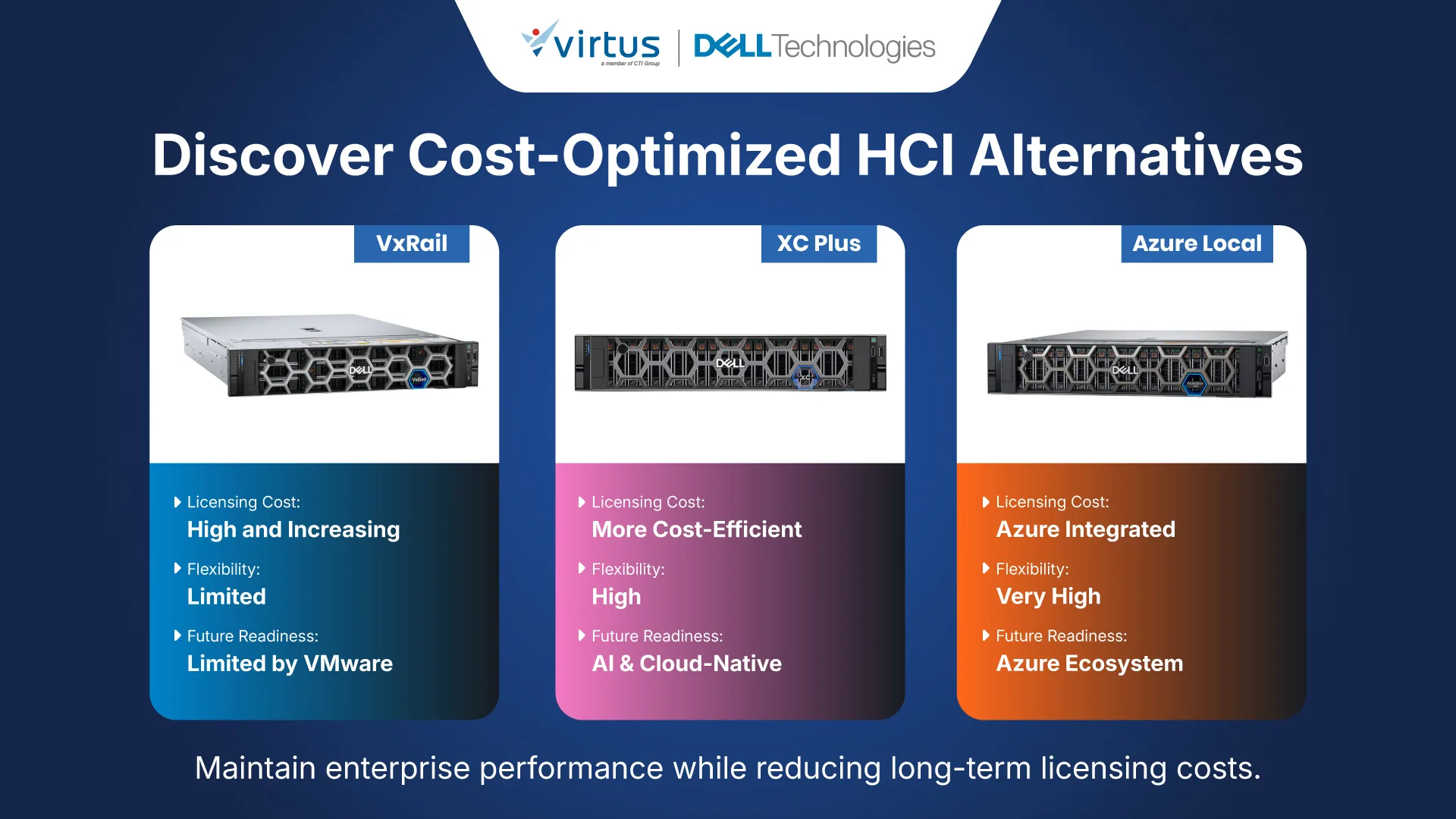
Strategic Comparison: VxRail vs DELL XC Plus vs DELL Azure Local
Strategic Aspect | VxRail | DELL XC Plus | DELL Azure Local |
| Hypervisor | VMware | Nutanix AHV | Azure Stack HCI |
| Licensing Cost | High & increasing | More cost-efficient | Integrated with Azure |
| Flexibility | Limited | High | Very high |
| Hybrid Cloud | VMware-centric | Multi-cloud ready | Azure-native |
| Future Readiness | VMware ecosystem (vendor lock-in) | Nutanix AHV ecosystem (vendor lock-in Nutanix) | Azure Stack HCI ecosystem (vendor lock-in Azure) |
Designing a Safe and Measured VxRail Exit Strategy
A VxRail exit strategy does not need to be disruptive. Many enterprises adopt phased approaches such as:
- Deploying new workloads on alternative platforms
- Migrating non-critical applications first
- Operating hybrid architectures during the transition
This approach helps minimize risk, maintain SLA compliance, and ensure business continuity.
Virtus Technology Indonesia’s Role in VxRail Transition and Replacement
Virtus Technology Indonesia (VTI), part of CTI Group, helps enterprises design and execute VxRail transitions that are secure, measured, and low-risk. Through a combination of technical and financial assessments, VTI ensures infrastructure decisions align with operational needs and long-term IT roadmaps.
VTI supports enterprises through:
- Comprehensive assessment of VxRail cost, performance, and risk
- Design of VMware cost optimization and VxRail exit strategies
- Implementation of DELL XC Plus and DELL Azure Local
- Phased, secure workload migration planning and execution
With extensive experience in large-scale enterprise infrastructure, VTI ensures transitions focus not only on platform replacement, but also on improved efficiency, flexibility, and hybrid cloud readiness.
Explore More: DELL Technologies Solutions on Virtus Technology Indonesia
Build a More Flexible and Future-Ready HCI with Virtus Technology Indonesia
With the support of an experienced partner like Virtus Technology Indonesia, transitioning from VxRail can become a strategic move to simplify operations, optimize costs, and establish a future-ready enterprise infrastructure.
Consult with Virtus Technology Indonesia today to identify the most effective HCI strategy for your organization.
Author: Ary Adianto
Content Writer, CTI Group