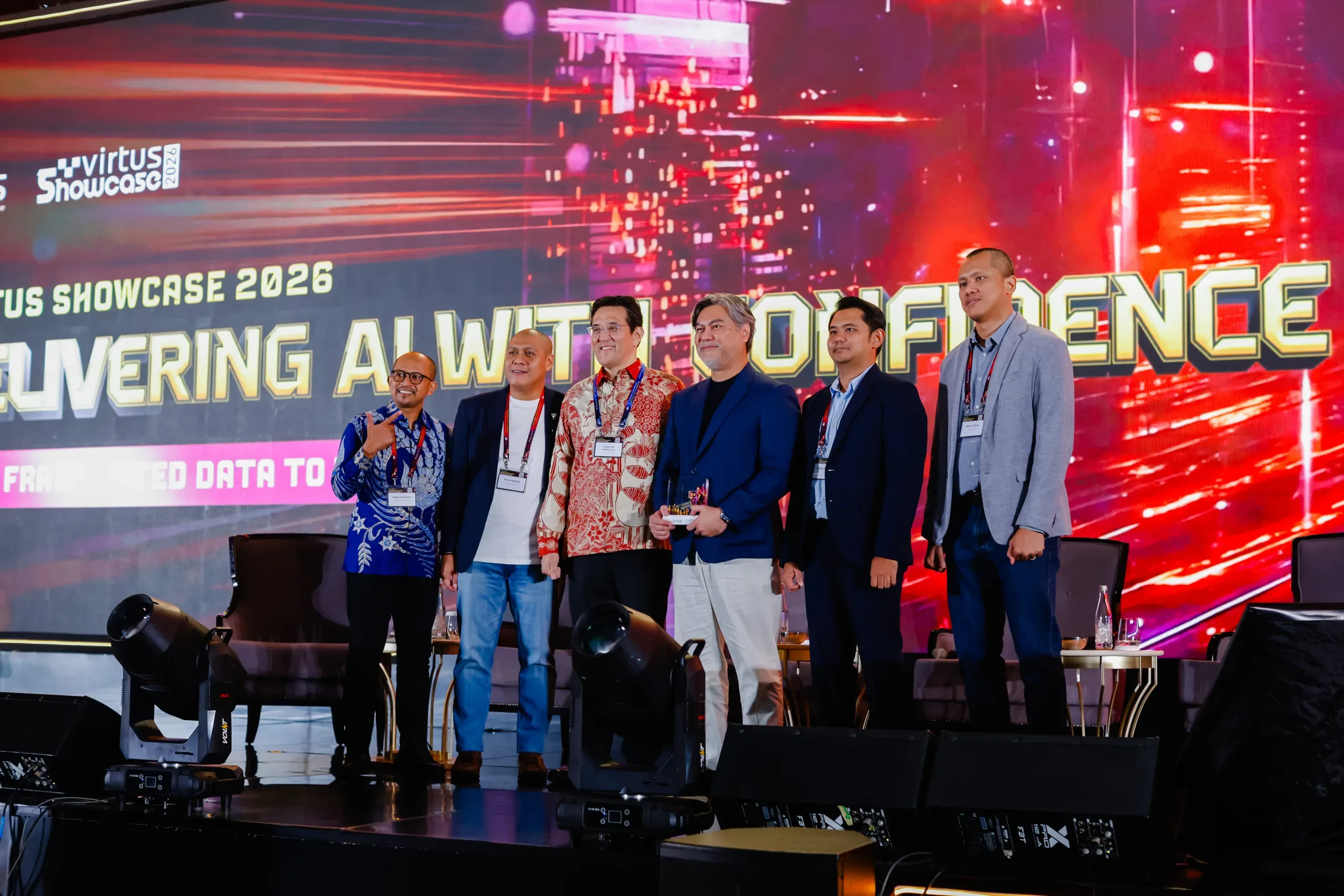
Jakarta, October 13, 2026 – PT Virtus Technology Indonesia (Virtus), a digital infrastructure solutions provider and subsidiary of CTI Group, hosted its annual Virtus Showcase 2026 at Raffles Hotel Jakarta. Building on last year’s discussion around enterprise readiness for artificial intelligence (AI) adoption, this year’s event focused on an increasingly critical aspect as AI becomes more deeply integrated into business processes: data readiness as the foundation for generating trusted insights and enabling reliable decision-making.
Under the theme ‘Delivering AI with Confidence: From Fragmented Data to Trusted Decisions’, Virtus Showcase 2026 explored how organizations can navigate increasingly complex data environments while ensuring that their data and supporting infrastructure are capable of consistently enabling AI adoption. Data readiness is becoming an increasingly important part of the enterprise AI journey. According to Gartner, by the end of 2026, organizations are expected to abandon 60% of AI projects that are not supported by AI-ready data.
The conference featured Alex Budiyanto, President of DAMA Indonesia, as the expert keynote speaker, who discussed the importance of data management in preparing organizations for AI adoption. Sharing the enterprise perspective, Norman Sasono, Chief Technology Officer (CTO) of DANA Indonesia, provided insights into the needs and challenges of managing data as AI becomes increasingly embedded in business environments.
The event also featured speakers from global technology companies, including Erwin Yusran, Data Center Solutions Lead, Indonesia, Dell Technologies, and Adrian Pramanta, Partner Development Manager, Data Center Solution Huawei, who shared perspectives on the role of infrastructure and connectivity in supporting technology environments that increasingly depend on data and AI.
“When AI becomes part of business processes, the quality of its outcomes is not determined solely by the models being used. We also need to look at the data behind those models, how that data is managed, and how the overall technology environment supports the process. If the foundation is not ready, increasingly sophisticated AI capabilities do not necessarily lead to better decisions,” said Christian Atmadjaja, Director of Virtus Technology Indonesia.
Ensuring Data Is Ready for AI
According to Alex Budiyanto, data management is becoming increasingly important as organizations adopt AI for various business needs. Data management is not only about storage, but also encompasses how data is developed, managed, protected, and maintained throughout its lifecycle.
One of the challenges companies frequently face is that the data available to them may not necessarily be ready for AI. Data may be incomplete, inconsistent, outdated, or fail to adequately represent actual conditions. Companies may also face differences in definitions, unclear data sources, and a lack of clear ownership for data quality.
Therefore, data quality, metadata, data standards, and data ownership are important foundations for ensuring that data can be understood, trusted, and used appropriately.
Alex emphasized that data quality should be assessed based on its intended use, or the principle of fit for purpose. Companies need to determine which decisions or business processes will be supported by AI, what data is required, the level of quality that must be achieved, and the risks that need to be anticipated.
“To assess data readiness for AI, companies can look at indicators such as accuracy, completeness, consistency, validity, duplication levels, and timeliness. The assessment should also consider how well the data represents real-world conditions, acceptable levels of bias, data lineage, as well as the accuracy and reliability of the labels being used,” Alex explained.
From a business perspective, Norman Sasono, CTO of DANA Indonesia, believes that simply using AI is not enough to create differentiation in an increasingly competitive environment. A company’s ability to leverage the data it owns is an important factor in generating relevant insights and supporting decision-making.
“As AI adoption continues to expand across companies, data is becoming an increasingly important differentiator. Every company has different data, and how that data is managed is key to creating business value. It is not the AI itself,” Norman concluded.
Infrastructure and Connectivity as Part of the Foundation
Beyond data management, AI readiness also needs to be viewed from the perspective of the technology environment in which data and workloads operate. Mohamad Rosidi, Director of ICT Strategy & Business, Huawei Indonesia, views AI through the lens of Huawei’s All Intelligence vision, where AI serves as a driver of transformation toward a more intelligent world by integrating intelligence across the entire digital value chain—from connectivity infrastructure, computing, and data storage to applications, business processes, and services.
During the Virtus Showcase 2026 media roundtable, Rosidi explained how this approach enables companies to improve productivity, optimize operations, and accelerate innovation through trusted data foundations, integrated digital infrastructure, and ecosystem collaboration. Together, these elements enable companies to transform data into insights, improve efficiency, and create value across the business value chain.
“For Huawei, All Intelligence means bringing intelligence to every part of the ecosystem, from infrastructure to applications, so that industries and stakeholders can leverage AI more effectively as an enabler for better decision-making, improved operational performance, and new growth opportunities. We believe the future of AI will be determined by our ability to connect data, networks, computing, and applications within an integrated, secure, and trusted ecosystem. Through this approach, together with the broader digital ecosystem, Huawei aims to support Indonesia in accelerating digital transformation, improving the quality of decision-making, and creating sustainable value for businesses and society,” said Rosidi.
Ultimately, discussions around AI should not stop at the technology’s ability to generate outputs. As AI becomes increasingly integrated into critical business processes, companies need to ensure that those outputs are supported by the right data and a reliable technology environment.
Virtus Showcase Jakarta 2026 was supported by various global technology companies, including Dell Technologies, Huawei, Arista, Forcepoint, Hikvision, and Red Hat.
About Virtus
Established in 2007, PT Virtus Technology Indonesia was acquired by CTI Group in 2011. Virtus delivers value by expanding market reach, offering a comprehensive product portfolio, increasing sales opportunities, and capturing emerging opportunities in Indonesia’s rapidly growing IT market.
With a vision to become a leading IT infrastructure solutions provider in Indonesia, Virtus has become a trusted choice for business partners and end users through its professional expertise in business and technology.
For more information, visit https://www.virtusindonesia.com/.
Media Contact:
Eribka – Public Relations CTI Group for Virtus