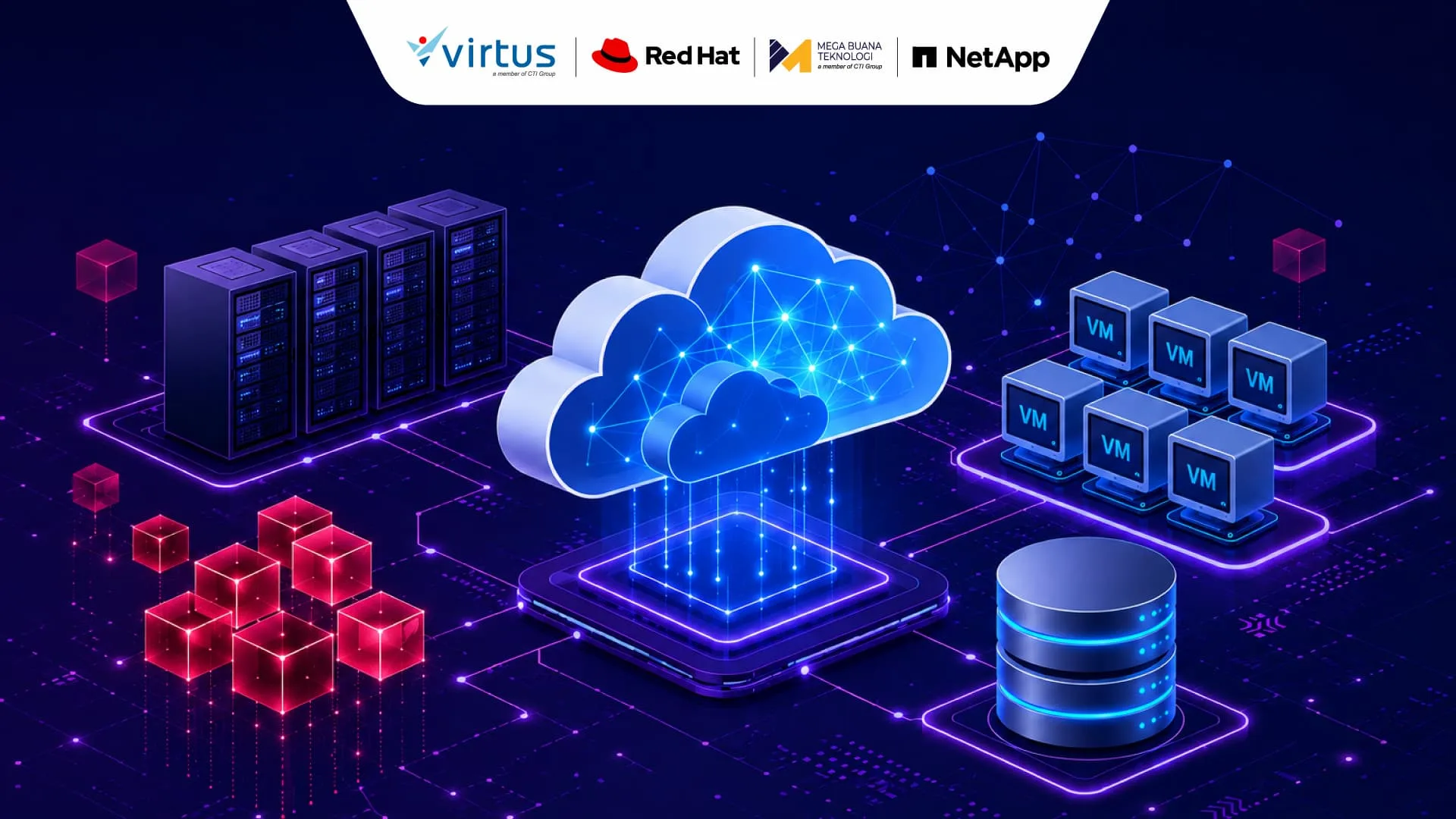
As business demands continue to evolve, many organizations now run Virtual Machines (VMs) and containers side by side. However, these environments are often managed on separate platforms, making IT operations more complex, increasing infrastructure costs, and slowing modernization efforts.
So, how can organizations unify VMs and containers without disrupting existing operations? This article explores how the combination of Red Hat OpenShift Virtualization and NetApp helps build a Unified Infrastructure for VMs and Containers, enabling organizations to modernize their infrastructure gradually, simplify operations, and avoid vendor lock-in.
Why Does Managing VMs and Containers on Separate Platforms Create Complexity?
For many years, virtual machines have been the foundation of enterprise IT infrastructure. As cloud-native applications continue to grow, however, many organizations have adopted Kubernetes and containers to accelerate application development and deployment.
The challenge is that these two environments are often managed independently. Infrastructure teams handle virtualization on one platform, while development teams manage containers through Kubernetes on another platform. As a result, deployment, monitoring, storage, and backup processes become disconnected.
This fragmented approach creates several challenges, including:
- Infrastructure silos
- Increasing operational complexity
- Multiple management tools
- Higher licensing and integration costs
- Inconsistent operations across hybrid cloud environments
- Slower application deployment
Beyond increasing operational overhead, this approach also makes it difficult for organizations to modernize applications gradually. Many businesses are forced to choose between maintaining legacy infrastructure or undertaking large-scale migrations that can disrupt operations.
Simplify Workload Migration with Red Hat OpenShift Virtualization
Red Hat OpenShift Virtualization addresses this challenge by providing a Unified Infrastructure for VMs and Containers. Organizations can run virtual machines and Kubernetes workloads on the same platform while maintaining a consistent operating model. IT teams no longer need to manage separate virtualization and container platforms, and developers can build modern applications without disrupting existing VM-based workloads.
This approach enables organizations to modernize infrastructure at their own pace while minimizing migration risks. Key capabilities include:
Live Migration
Move virtual machines between nodes without interrupting running applications, helping minimize downtime during maintenance or capacity expansion.
Migration Toolkit for Virtualization
Simplifies VM migration to OpenShift Virtualization, allowing organizations to migrate workloads gradually with lower operational risk.
High Availability (HA)
Keeps critical applications running even when infrastructure failures occur, supporting business operations that require continuous availability.
Integrated Monitoring
Provides centralized visibility into the performance of both virtual machines and containers from a single monitoring platform.
Multi-Environment Support
Supports deployments across on-premises and public cloud environments, giving organizations greater flexibility in implementing hybrid cloud strategies.
Why Does Infrastructure Modernization Require a Strong Storage Foundation?
Infrastructure modernization is not only about compute resources. Storage plays an equally important role in supporting both virtual machines and containers. It must deliver high performance, flexible capacity, and scalability to accommodate growing workloads. Without the right storage foundation, modernization initiatives can quickly face operational bottlenecks and performance challenges.
To address these requirements, NetApp Storage Solutions integrate seamlessly with Red Hat OpenShift, enabling organizations to manage data consistently across on-premises and hybrid cloud environments while supporting both modern applications and traditional virtual machine workloads.
In addition, NetApp Trident integrates with Kubernetes to automate storage provisioning, simplifying infrastructure management, and improving operational efficiency. As a result, organizations gain a scalable and flexible storage foundation that supports long-term infrastructure modernization and hybrid cloud adoption.
Backup, Recovery, and Resilience Strategies with Red Hat and NetApp for Hybrid Cloud
By combining Red Hat OpenShift Virtualization with NetApp, organizations can build an integrated strategy for backup, recovery, and data resilience. This solution helps protect both virtual machine and container workloads, accelerates recovery during disruptions, and ensures application availability across hybrid cloud environments.
| Capability | Business Benefit |
| Integrated Backup | Protects virtual machines and containers with simpler and more consistent backup processes. |
| Disaster Recovery | Speeds up service recovery, minimizing downtime while helping achieve RPO and RTO objectives. |
| Data Resilience | Protects business-critical data against operational failures and ransomware threats. |
| Hybrid Cloud Protection | Delivers consistent data protection across on-premises and hybrid cloud environments. |
| High Availability | Keeps business applications running continuously to support uninterrupted operations. |
Business Benefits of Red Hat and NetApp: Reducing Operational Complexity and Infrastructure TCO
Managing separate platforms for virtualization, containers, storage, and data protection often increases the Total Cost of Ownership (TCO). Organizations must invest not only in licensing but also in integration, skills development, and ongoing operational management.
By combining Red Hat OpenShift Virtualization with NetApp, organizations can simplify infrastructure management while building a more flexible and future-ready platform.
| Benefit | Business Impact |
| Unified Infrastructure for VMs and Containers | Manage virtual machines and containers from a single platform. |
| Reduced Operational Complexity | Simplify IT operations through a consistent management workflow. |
| Faster Workload Migration | Migrate virtual machines more efficiently and with lower risk. |
| Open Ecosystem | Reduce dependency on proprietary platforms and avoid vendor lock-in. |
| Hybrid Cloud Flexibility | Run workloads seamlessly across on-premises and cloud environments. |
| Enterprise Storage Integration | Unify storage, backup, and recovery management. |
| Future-Ready Infrastructure | Build a scalable foundation for hybrid cloud, AI, and cloud-native applications. |
Start Your IT Infrastructure Modernization Journey with Virtus Technology Indonesia and Mega Buana Teknologi
Through the collaboration between Virtus Technology Indonesia (VTI) as an official Red Hat partner and Mega Buana Teknologi (MBT) as a NetApp solutions provider, organizations can build a Unified Infrastructure for VMs and Containers that is simpler to manage, highly scalable, and ready to support hybrid cloud transformation and future AI initiatives.
With Red Hat OpenShift Virtualization and NetApp, organizations can modernize infrastructure gradually without disrupting existing workloads while establishing a reliable enterprise storage foundation for backup, recovery, and data resilience.
Consult the experts at Virtus Technology Indonesia and Mega Buana Teknologi to assess your VM and container infrastructure readiness and develop the right modernization strategy for your business.
Author: Ary Adianto
Content Writer, CTI Group