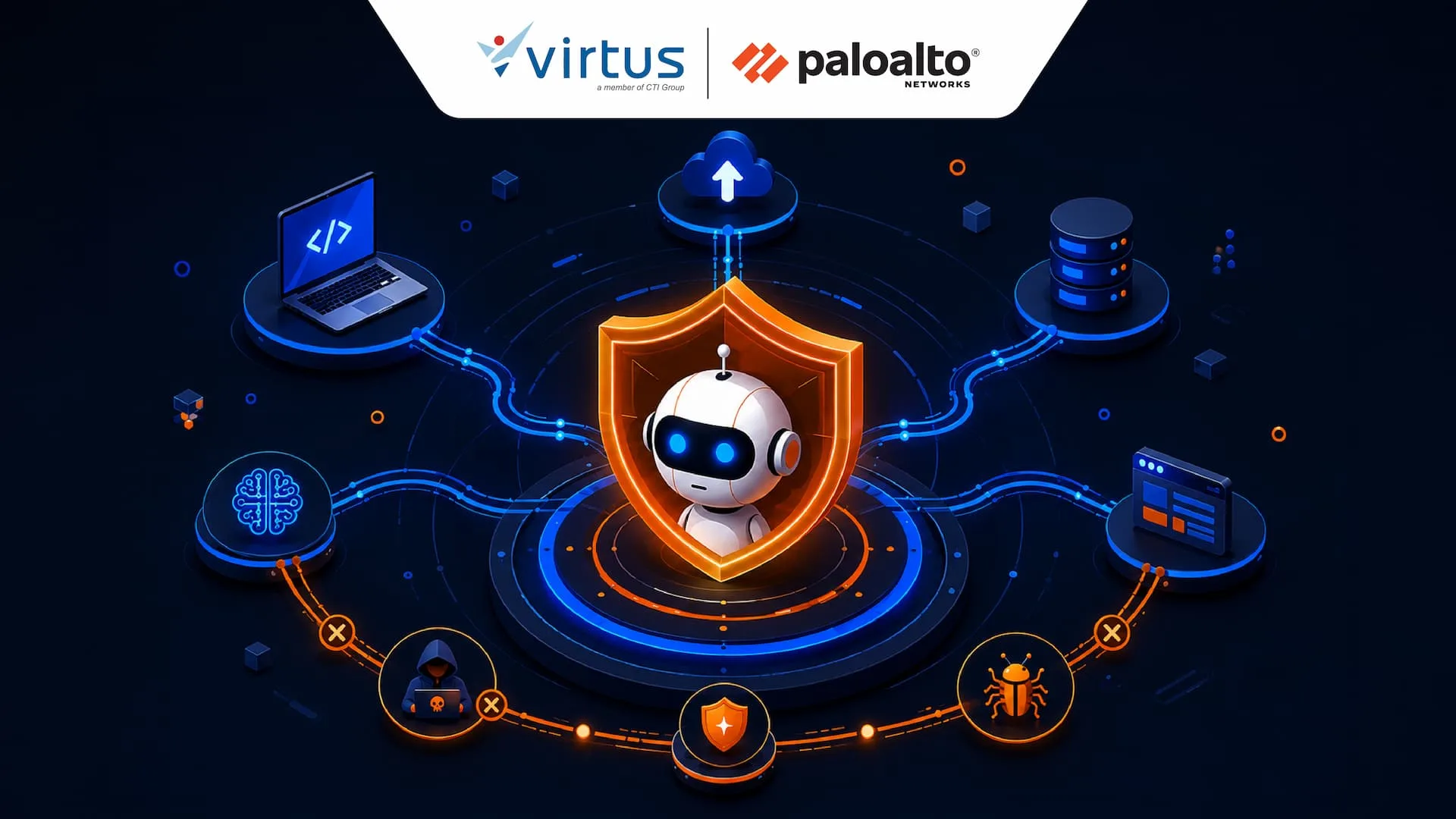
AI adoption continues to grow across businesses, from Microsoft Copilot to custom AI agents designed to support internal operations. However, the more access AI has to company data and systems, the greater the risks, including prompt injection, malicious tool calls, and data leakage.
Traditional security tools may not be able to recognize threats specific to how AI agents operate. This is why enterprises need AI Agent Security that can protect AI from development through runtime.
To address this need, Palo Alto Networks introduced Prisma AIRS (AI Runtime & Agent Security). The platform helps protect the entire AI lifecycle, from before deployment to when agents are running, allowing enterprises to adopt AI more securely without losing control over critical data and systems.
Why Aren’t Traditional Security Tools Enough to Protect Agentic AI?
AI agents can operate more independently than traditional applications. They can receive instructions, make decisions, access databases, use tools, and perform certain actions. This capability means enterprises need to approach AI security from multiple angles.
Know Where AI Agents Operate
Enterprises need to know which AI agents are being used, which systems they connect to, and what data they can access. Without this visibility, security teams may struggle to understand the full attack surface across the organization.
Assess Agent Risks and Access Rights
Each AI agent may have access to specific applications, databases, APIs, or tools. If permissions are too broad, an agent could perform actions beyond what it actually needs. Enterprises therefore need to understand the agent architecture and ensure each identity has the appropriate level of access.
Stop Threats While AI Is Running
Risks can also emerge while an AI agent is operating. Direct prompt injection can provide malicious instructions directly, while indirect prompt injection can hide instructions inside external data or sources that the AI reads.
Poisoned RAG can also affect the information an AI uses to make decisions. Other risks include malicious tool calls and the leakage of sensitive data such as PII. This makes AI Agent Security an active layer of protection rather than something used only after an incident occurs.
Protect AI Before Deployment with Agent Scanning and AI Red Teaming
AI security should not begin only after an agent reaches production. Prisma AIRS helps enterprises identify potential risks during the pre-production stage through Agent Artifact Scanning and AI Red Teaming.
Agent Artifact Scanning Finds Vulnerabilities Earlier
Agent Artifact Scanning helps examine the code and components of AI agents to identify potential attack chains before they reach production. This can be applied to agents built with frameworks such as LangChain, CrewAI, and AutoGen.
AI Red Teaming Based on Agent Architecture
AI Red Teaming helps enterprises test how AI agents respond to different attack scenarios. Prisma AIRS can simulate more than 500 types of attacks to identify weaknesses that attackers could potentially exploit.
The testing is not limited to generic scenarios. Simulations can be adapted to the architecture and tools used by each agent, making the results more relevant to the enterprise environment. Findings can also be mapped to standards such as OWASP, NIST AI RMF, and MITRE ATLAS.
AI Runtime Security Helps Protect Agents in Real Time
Once an AI agent enters production, protection must continue while the agent interacts with users, applications, data, and tools. Prisma AIRS AI Runtime Security helps monitor these activities and act when threats are detected.
AI Agent Gateway as a Central Control Point
AI Agent Gateway acts as a central control point for monitoring traffic between AI agents and connected systems. With centralized control, enterprises can gain clearer visibility into agent activity and apply security policies based on their needs.
Each Agent Has Its Own Identity and Access Rights
Prisma AIRS takes an identity-first approach by giving each AI agent a unique identity. Agent access can be limited based on the required permissions and usage period.
This approach helps reduce the risk of overprivileged identities because agents do not need full access to every system.
Threat Detection in Milliseconds
Real-time protection needs to maintain application performance. Prisma AIRS offers detection latency of around 110 ms, allowing threats to be detected quickly without significantly affecting application performance.
This capability helps enterprises respond to threats before malicious activity develops into a larger incident or causes sensitive data to leave the enterprise environment.
Securing SaaS Agents and Developer Endpoints
Enterprise AI adoption does not only come from custom AI agents. Many organizations also use SaaS agents and AI coding tools in their daily operations. AI protection therefore needs to cover cloud, SaaS, and endpoints.
Control Over SaaS Agents
Prisma AIRS provides visibility into SaaS agents such as Microsoft Copilot, Salesforce Agentforce, and ServiceNow. Enterprises can apply the principle of least privilege so each agent receives only the access it needs.
Protecting AI Activity on Developer Endpoints
AI coding tools such as Cursor and Claude Code can interact with source code, files, and resources on developer devices. Without proper controls, these activities could increase the risk of source code or internal data leakage.
Agentic Endpoint Security from Prisma AIRS helps secure AI usage on developer endpoints, allowing enterprises to use AI coding tools with stronger security controls.
Visibility and Compliance in One Platform
Securing AI is not only about stopping attacks. Enterprises also need to understand the security posture of their AI agents and have information that can support evaluation and audits.
Prisma AIRS provides centralized visibility across AI agents in different environments. Risks can be monitored through risk scores, while testing results and security activity can support audit-ready reporting.
The platform also provides compliance mapping that connects AI security controls with frameworks such as OWASP, NIST, and MITRE ATLAS. This approach helps enterprises strengthen security while simplifying compliance processes.
Prisma AIRS Palo Alto Networks for Safer AI Adoption
As more enterprises adopt AI agents, it becomes increasingly important to know which agents are being used, what data they can access, and what actions they perform. Enterprises need protection that goes beyond the network or endpoint and covers the entire AI lifecycle.
Prisma AIRS Palo Alto Networks combines pre-production scanning, AI Red Teaming, AI Runtime Security, Agent Identity Security, SaaS Agent Security, and Agentic Endpoint Security in one platform. This approach gives enterprises greater control and visibility from development through operational use.
Prisma AIRS is also supported by Unit 42 threat intelligence and trusted by more than 70,000 customers worldwide. With this approach, enterprises can develop and use AI more securely without compromising business needs.
Scale Enterprise AI Innovation Securely with Virtus Technology Indonesia
AI adoption does not mean losing control over company data and systems. With protection from pre-deployment through runtime, enterprises can identify risks earlier, monitor agent activity, and respond to threats in real time.
Virtus Technology Indonesia, part of CTI Group and an official Palo Alto Networks distributor in Indonesia, is ready to help enterprises evaluate their AI Agent Security needs through architecture consultation, demos, and Prisma AIRS implementation. Contact Virtus Technology Indonesia to learn how Prisma AIRS can help strengthen AI security, support AI data loss prevention, and enable safer and more controlled enterprise AI adoption.
Author: Ary Adianto
CTI Group Content Writer