
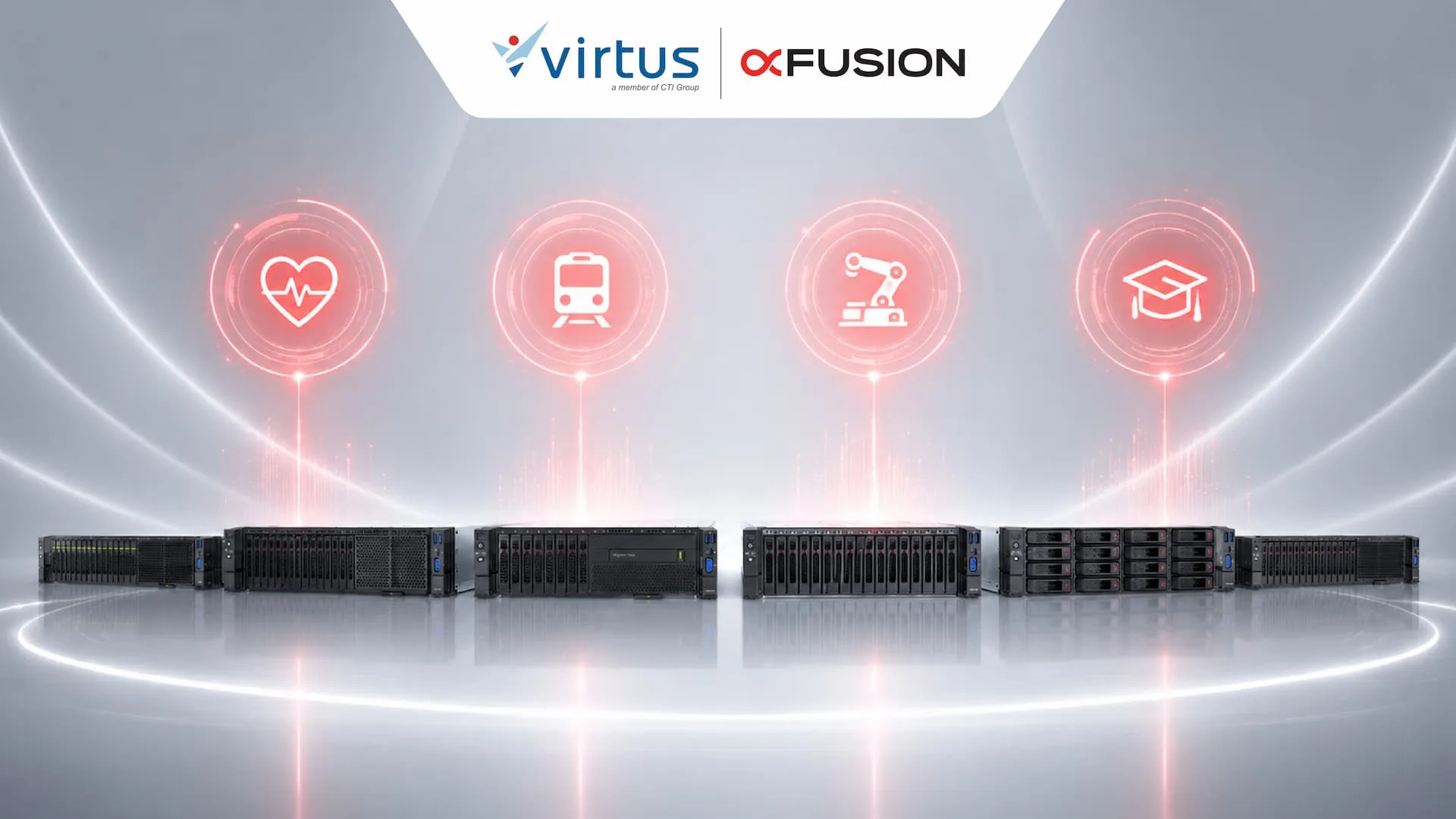
Organizations today increasing pressure to operate IT infrastructure that is faster, more flexible, and more efficient. According to Gartner, many enterprises are moving away from traditional data center models due to operational complexity and high maintenance costs that limit business agility. At the same time, modern workloads such as AI, analytics, and hybrid cloud environments continue to drive demand for infrastructure that is simpler, more scalable, and more cost-efficient.
This trend is accelerating the adoption of Hyperconverged Infrastructure (HCI) as a modern approach to simplifying data center operations. The need for systems that are easier to manage, highly scalable, cost-effective, and capable of supporting AI integration and automation has become a key driver behind HCI market growth.
This is where xFusion FusionOne HCI comes in as a a fully integrated hyperconverged platform that combines compute, storage, networking, and management into a unified ecosystem designed for modern enterprises.
Traditional Data Center Challenges: Why Infrastructure Complexity Slows Business Growth?
Many enterprises still rely on fragmanted IT infrastructure where compute, storage, and networking systems operate independently. This approach often creates resource silos that lead to inefficient infrastructure utilization while increasing management complexity and operational costs.
In addition, high operational expenditure (OpEx) remains a significant challenge. IT teams must manage multiple tools, perform separate maintenance activities, and handle more complicated troubleshooting processes because each infrastructure layer operates independently. As a result, application deployment becomes slower and struggles to keep pace with rapidly evolving business requirements.
As digital transformation initiatives continue to accelerate, organizations require infrastructure that is more flexible, agile, and scalable. This is one of the primary reasons many businesses are adopting Hyperconverged Infrastructure (HCI) to consolidate resources into a single integrated platform.
HCI breaks the cycle of infrastructure complexity by integrating all infrastructure layers into a software-defined platform running on industry-standard hardware. It enables unified management, dynamic resource pooling, and rapid scalability within a single, streamlined environment.
Introducing xFusion FusionOne HCI: A True Hyperconverged Platform for Modern Enterprises
xFusion is not a new player in the computing infrastructure industry. FusionOne HCI is built on more than a decade of deep hyperconverged infrastructure R&D expertise, delivering an integrated package that combines ready-to-use software and hardware, including compute virtualization and distributed storage software. It also supports application deployment requirements for cloud management, disaster recovery, security, and various business workloads. This approach enables enterprises to eliminate traditional infrastructure complexity while improving overall data center efficiency.
What differentiates xFusion FusionOne HCI from many other HCI solutions is its True Hyperconverged Platform approach. Rather than simply bundling servers with third-party software, xFusion delivers deep integration across compute, storage, networking, and management components that were designed from the ground up as a unified system.
The platform is built upon four key pillars: convergence (integrating all infrastructure layers), intelligent O&M capabilities (to improve operational efficiency), openness (an open architecture compatible with industry ecosystems), and reliability (enterprise-grade dependability).
FusionOne HCI also embraces an Intelligent and Open Architecture approach, providing greater flexibility for diverse business requirements. From a performance perspective, xFusion achieved global recognition by earning the 2023 World’s No. 1 ranking in the SPECvirt benchmark—the industry’s most widely recognized benchmark for measuring enterprise virtualization platform performance. This achievement demonstrates its ability to support enterprise virtualization workloads with exceptional stability and efficiency.
Key xFusion HCI Features for Data Center Automation and Performance
xFusion FusionOne HCI is powered by 5th Generation Intel® Xeon® processors designed to handle heavy workloads with high performance. This infrastructure can efficiently support virtualization workloads, analytics, databases, and AI processing with low latency and optimized computing efficiency.
Support for intelligent resource scheduling and memory optimization also ensures maximum resource utilization without compromising the performance of mission critical business applications.
Unified Management via FusionOne Center
Through FusionOne Center, organizations can centrally manage all IT resources through a single unified dashboard. IT teams can monitor and control multi-site and multi-cluster environments without switching between multiple management tools. This centralized management approach improves infrastructure visibility while accelerating troubleshooting and daily operations.
One Click Deployment and Simplified Operations & Maintenance
xFusion FusionOne HCI significantly simplifies infrastructure deployment through its one-click deployment capability. Organizations can implement infrastructure faster with automated configuration processes that help reduce human error.
In addition, automated Operations & Maintenance (O&M) capabilities simplify day-to-day infrastructure management, significantly reducing administrative workload for IT teams.
High Scalability up to 256 Nodes
Business demands continue to evolve, and infrastructure must be able to scale accordingly. xFusion FusionOne HCI supports scalability of up to 256 nodes, enabling organizations to expand resources flexibly without disrupting ongoing operations. This highly scalable architecture helps enterprises prepare for long-term growth without requiring major infrastructure redesigns.
Business Advantages: Cost Efficiency Through Resource Pooling
One of the main advantages of HCI solutions is resource pooling, which enables compute, storage, and networking resources to be utilized more efficiently within a unified platform.
This approach reduces resource waste while lowering Total Cost of Ownership (TCO). Infrastructure management also becomes significantly simpler, eliminating the need for multiple standalone systems and management tools. Beyond these benefits, xFusion HCI delivers several additional business advantages.
Measurable TCO Reduction
Consolidating infrastructure into FusionOne HCI delivers direct cost savings across multiple areas:
- Software licensing: A single integrated platform replaces separate licenses for hypervisors, storage software, and network management tools.
- Physical space and power consumption: Data center footprint is significantly reduced through infrastructure consolidation.
- IT workforce costs: Centralized management reduces the need for multiple domain specialists while lowering training and consulting expenses.
- Maintenance costs: One vendor, one support contract, and one escalation path instead of managing three or four separate vendors.
Faster Response to Business Demands
When business units require new environments for applications or projects, IT teams no longer need to go through lengthy procurement cycles. Resources can be provisioned on demand from existing resource pools, and deployment can be completed within hours.
This agility creates tangible business value by shortening time-to-market and enabling greater innovation and experimentation.
Enterprise Grade Reliability: Ensuring Business Continuity Without Downtime
For enterprises, downtime is not only a technical issue but also a business risk that can significantly impact operations and corporate reputation. That is why xFusion FusionOne HCI includes a range of enterprise-grade reliability capabilities designed to ensure uninterrupted business continuity.
Built-in Disaster Recovery (DR) and High Availability (HA) capabilities help maintain continuous operations even during infrastructure disruptions. Automated fault recovery technology further minimizes downtime by enabling systems to recover automatically from failures.
xFusion also incorporates predictive maintenance and predictive analytics capabilities to identify potential failures before they impact business operations. This proactive approach helps organizations improve reliability while maintaining consistent IT service stability.
FusionOne HCI also implements multi-layer security measures, including encryption for data at rest and in transit, Software-Defined Networking (SDN), granular access authentication, and comprehensive audit trails to support regulatory compliance requirements.
Prepare Your Future IT Infrastructure with xFusion Only at Virtus
Data center modernization has become a critical priority for enterprises seeking greater efficiency, scalability, and business agility. By fully integrating compute, storage, networking, and security into a single platform, xFusion FusionOne HCI enables organizations to simplify IT infrastructure without sacrificing performance or reliability.
Virtus, part of CTI Group is a trusted xFusion partner dedicated to helping organizations modernize their business infrastructure. Backed by experienced technology experts, Virtus can help your organization design and implement an HCI strategy that is more efficient, scalable, and future-ready.
Schedule a consultation with Virtus team today and start transforming your data center into a faster, more reliable, and simpler platform for the future.
Author: Ervina Anggraini – Content Writer CTI Group