
As organizations accelerate the adoption of VDI, cloud, and hybrid workspaces, the way applications are managed is evolving rapidly. However, many companies are still relying on outdated approaches to application management, particularly static golden images that are difficult to maintain and scale.
While this method may have worked in the past, it is no longer effective in today’s modern application environment, where applications are constantly updated, interconnected, and business-critical.
As a result, the need for a more flexible, faster, and efficient approach to application management has become increasingly urgent.
Traditional Application Management Challenges: From Image Sprawl to Compatibility Issues
In traditional VDI environments, application management heavily depends on golden images. Applications are installed into a single image and then distributed across multiple virtual machines for virtual desktops.
At first glance, this approach seems simple. But as organizations scale, complexity grows rapidly. One of the most common challenges is image sprawl, where multiple image versions must be maintained to meet different requirements. Even minor application updates can trigger a full image rebuild, consuming time and resources.
Another major issue is compatibility. Not all applications can run smoothly together within the same environment. Dependency conflicts, version mismatches, and configuration requirements often lead to application conflicts.
As a result:
- Deployment becomes slower
- Error risks increase
- IT workload grows significantly
To address these challenges, organizations are shifting toward modern approaches like Omnissa App Volumes, designed to simplify application delivery and management with greater flexibility.
Introducing Omnissa App Volumes, the Evolution of VMware App Volumes
Omnissa App Volume is a modern solution for application management that enables real-time application delivery without modifying the underlying operating system.
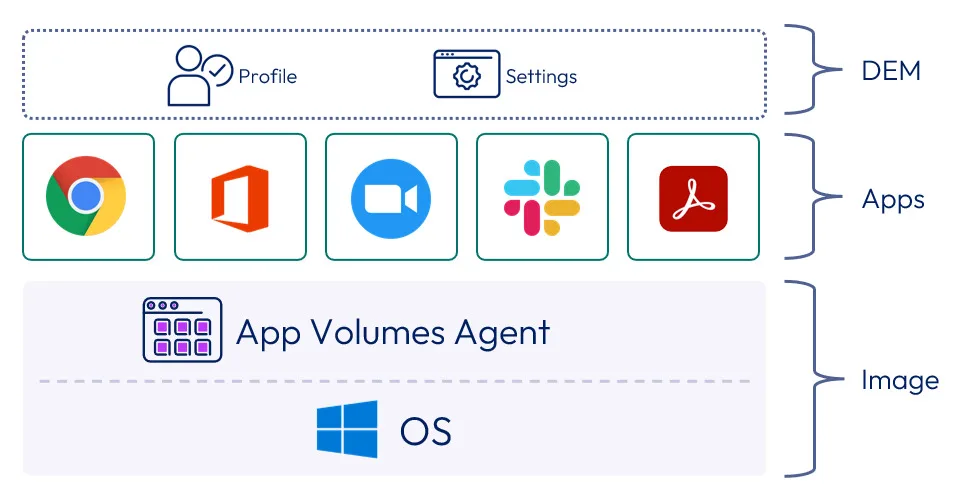
As the evolution of VMware App Volumes, this solution is built to meet the demands of dynamic modern application environments. Instead of installing applications directly into the OS, Omnissa App Volume uses an application layering approach through virtual disks (VMDK/VHD).
This means:
- Applications are packaged once
- Delivered to multiple users or virtual machines
- Without the need to rebuild images
This approach significantly simplifies application management, making it more flexible and scalable.
Why Do Businesses Need Omnissa App Volumes?
In today’s business environment, speed and efficiency are critical. With Omnissa App Volume, organizations can optimize application management while improving operational efficiency.
1. Cost Efficiency
By reducing dependency on multiple images:
- Storage usage becomes more efficient
- Infrastructure is optimized
- Operational costs are reduced
2. Zero-Downtime Updates
Application updates no longer disrupt operations:
- Applications can be updated without downtime
- No need to rebuild images
- Quick rollback capabilities
3. Security and Compliance
In modern application management, centralized control is essential:
- Faster deployment of security patches
- Centralized application control
- Reduced endpoint security risks
This is especially critical for industries such as banking, government, and healthcare.
Key Features That Transform IT Operations
Source: Omnissa Tech Zone
Omnissa App Volume not only simplifies application management but also introduces advanced capabilities that transform how IT teams operate.
Apps on Demand
With this feature, applications are not loaded during login but are attached only when needed.
Benefits include:
- Faster login times
- More efficient resource usage
- A smoother user experience
This represents a more adaptive approach to modern application delivery.
Writable Volumes
This feature provides each user with a dedicated storage space for personal data and application settings.
As a result:
- User experience remains consistent
- Data persists across devices
- Supports modern, flexible work environments
In the context of application management, this creates a balance between IT control and user flexibility.
Omnissa App Volumes vs. Cloudpaging: Which One Is Right?
Other solutions like Cloudpaging also offer modern approaches to application management.
Cloudpaging uses a container-based streaming method to deliver applications, which can be effective in certain scenarios.
However, Omnissa App Volume provides distinct advantages for enterprise environments:
- Native integration with Omnissa and Horizon ecosystem
- Support for Citrix and RDSH
- Mature centralized management
- Stable and predictable performance through virtual disks
For large-scale modern application environments, Omnissa App Volume offers a more integrated and enterprise-ready solution.
Read More: Transforming Legacy Systems: How Application Modernization Powers the Cloud-Native Future
It’s Time to Embrace Modern Application Management with Virtus
The way IT operates continues to evolve. Applications are growing in number, systems are becoming more complex, and businesses are under constant pressure to move faster. Relying on traditional application management approaches only leads to slower processes, higher costs, and increased risks.
This is where Omnissa App Volume delivers a simpler and more modern approach. Applications can be managed more flexibly, delivered in real time, and updated without disrupting operations, allowing IT teams to work more efficiently while ensuring optimal user experience.
With Virtus Technology Indonesia (part of CTI Group), organizations can implement this solution end-to-end, tailored to their specific business needs. Build a more agile, scalable, and future-ready application management strategy today. Contact Virtus for a FREE consultation and demo.
Author: Ary Adianto
Content Writer, CTI Group