In today’s fast-moving and highly competitive landscape, businesses are under constant pressure to innovate faster. IT infrastructure is no longer just a support function—it has become a critical factor in determining how quickly new ideas can be developed, deployed, and scaled.
However, the reality is that many organizations, from banking to manufacturing, still operate with fragmented systems. Virtual Machines (VMs), containers, and AI workloads are often managed on separate platforms, by different teams, using different tools. This fragmented approach may seem manageable at first, but over time it creates inefficiencies that slow down innovation.
Without realizing it, these silos lead to slower business processes, rising operational costs, and increased risk. This is where OpenShift steps in, offering a new approach by unifying all workloads into a single, integrated platform that is simpler, more scalable, and more secure.
What is Red Hat OpenShift?
Red Hat OpenShift is an enterprise Kubernetes platform designed to simplify the development, deployment, and management of modern applications within a unified ecosystem.
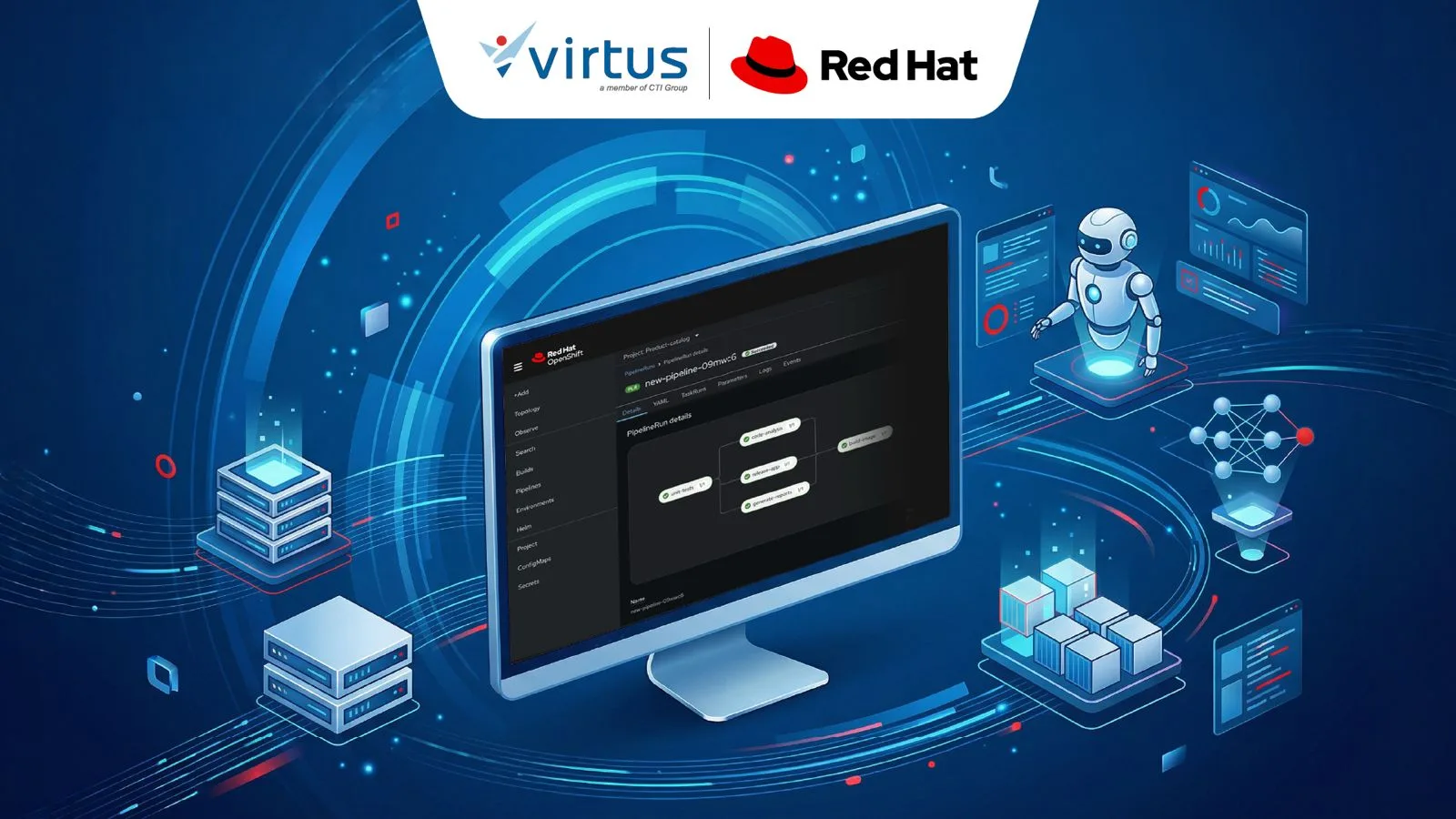
More than just a container platform, OpenShift has evolved into a unified foundation capable of running multiple types of workloads simultaneously, including:
- Container-based applications
- Virtual Machines (VMs) through OpenShift Virtualization
- AI/ML workloads through OpenShift AI
This approach allows organizations to eliminate the divide between legacy and modern infrastructure. Everything runs consistently across data centers, hybrid cloud, and multi-cloud environments. In essence, OpenShift simplifies not only technology but also how IT teams and developers work together.
Why Siloed Infrastructure Slows Down Innovation
Over the years, many organizations have built their IT infrastructure incrementally, adapting to business needs at different stages. The result is fragmented or siloed environment.
VMs, containers, and AI workloads operate within distinct environments, each managed independently to address the specific requirements of different teams.
While this setup may appear logical, in practice it creates a domino effect:
- Increased operational complexity and inefficiency
- Slower deployment due to cross-platform integration challenges
- Higher costs from duplicated tools and resources
- Greater security risks due to limited visibility
These challenges make it difficult for organizations to stay agile in an increasingly dynamic market. OpenShift addresses this by breaking down silos and delivering a single, unified platform for all workloads.
OpenShift vs Kubernetes: What’s the Difference?
Kubernetes has become the standard for container orchestration. However, in real-world enterprise environments, Kubernetes often require extensive integration to be fully operational.
This is where OpenShift stands out.
If Kubernetes is the “engine,” OpenShift is the complete, ready-to-use platform. It comes with built-in capabilities such as:
- Security by default with enterprise-grade compliance
- Integrated CI/CD pipelines for automated deployment
- Built-in monitoring and logging
- Developer tools that streamline application development
With this approach, organizations don’t need to build everything from scratch. OpenShift accelerates adoption while reducing risk and implementation time.
Red Hat OpenShift Virtualization: Bridging Modernization from VMware
For many enterprises, migrating legacy systems is not easy, especially when critical applications still rely on Virtual Machines.
At the same time, the shift toward container-based architecture is becoming unavoidable.
OpenShift Virtualization acts as a bridge between these two worlds. By enabling VMs to run within the OpenShift platform, organizations can:
- Manage VMs and containers in a single platform
- Reduce dependency on traditional virtualization solutions like VMware
- Modernize gradually without disrupting existing operations
This approach offers greater flexibility while paving the way for broader digital transformation.
Read More: Why Enterprises Are Looking Beyond VMware for Their Next Virtualization Platform
Build Intelligent Apps Faster with Red Hat OpenShift AI
As AI adoption grows, many organizations realize that the biggest challenge is not technology itself, but integration.
How can AI be embedded into existing systems without adding complexity?
Red Hat OpenShift AI addresses this by providing a platform to build, train, and run AI models within the same ecosystem as other applications.
With support for:
- Scalable infrastructure for model training
- Seamless integration with existing applications
- Edge computing for low latency
- Serverless capabilities (Knative) for resource efficiency
OpenShift enables organizations to develop intelligent applications faster and more efficiently.
Read More: A Deep Dive into Red Hat OpenShift AI: A Smart Solution for Cloud-Native Optimization
Economic Benefits: Turning Infrastructure into a Strategic Asset
In recent years, the perception of IT infrastructure has shifted. What was once seen as a cost center is now recognized as a key driver of business growth.
With OpenShift, organizations can take a more strategic approach:
Operational Cost Efficiency
A single platform for VMs, containers, and AI reduces investment needs and simplifies management.
Faster Time-to-Market
Automation through pipelines and GitOps accelerates application deployment.
Adaptive Scalability
Applications can dynamically scale based on business demand.
Security and Compliance
Built-in security features such as SELinux and OAuth integration help meet industry standards.
Future-Proof Without Vendor Lock-in
Organizations gain the flexibility to move across cloud environments without redesigning applications.
With this approach, infrastructure evolves from a cost burden into a strategic asset that drives competitive advantage.
It’s Time to Modernize Your Infrastructure with Red Hat OpenShift and Virtus
Digital transformation is no longer about “if,” but “how fast.” To keep up, organizations need a platform that is not only powerful, but also flexible and fully integrated.
Red Hat OpenShift provides that foundation, combining virtualization, containers, and AI in a unified platform. Together with Virtus Technology Indonesia, businesses can adopt OpenShift with the right strategy, from infrastructure modernization to AI-driven application development.
As part of CTI Group, Virtus is ready to support cross-industry transformation with systems that are more agile, efficient, and secure. Now is the time to move away from legacy complexity and embrace a platform that truly enables sustainable innovation.
Author: Ary Adianto
Content Writer CTI Group